

Healthcare Software Development, built with clinicians, not just for them.
We build the EHR overlays, telehealth platforms, patient apps, and revenue-cycle tools that let clinicians spend less time on paperwork and more time with patients. Every system we ship is designed around real clinical workflows and built to hold up under a regulator's second look, not just a product demo.
Five years of healthcare change, compressed into one.
Telehealth, EHR modernization, and clinical AI all matured faster than most health systems planned for. The providers pulling ahead are treating software as core infrastructure — not a project bolted onto whatever they already had.
Projected Global Virtual Care Spend by 2026
Virtual visits, remote monitoring, and digital triage moved from pandemic stopgap to permanent infrastructure. Health systems now budget for them the way they budget for beds.
Stitching together consumer video tools invites HIPAA exposure the moment an auditor looks closely. A WebRTC pipeline built directly into the EHR keeps care continuous and keeps reimbursement intact.
Physicians Now Charting Digitally
Most providers already have a digital record. The real engineering work now is interoperability — FHIR middleware and workflow overlays that make the record actually usable, not just present.
The chart exists; the clinician is exhausted. Ambient charting that cuts documentation time in half is what actually wins hospital contracts today.
Annual Growth in Assisted Diagnostics
AI-assisted diagnostics — radiology triage, pathology review, pre-op planning — are moving out of pilot programs and into formal clinical protocol.
A model only earns bedside adoption when it lives inside PACS and the EHR itself. One extra login is one more reason a clinician quietly stops using it.
The pressures rewriting how care gets delivered.
Hybrid care is the default now, not the exception
Global telemedicine is on track for $185.66B by 2026. Patients expect a virtual-first option, with in-person visits reserved for when they actually matter.
The record exists — using it well is the hard part
90% of physicians already work inside an EHR. The next real edge is interoperability and analytics layered on top, not digitizing more paper.
AI is entering the clinical loop, carefully
From imaging to ambient scribing to decision support, validated AI is moving from pilot to protocol, with an ROI case that actually holds up to audit.
Burnout is a staffing crisis with a software fix
Clinician burnout, aging populations, and workforce shortages call for tools that remove administrative load, not another dashboard to check.
Patients compare your app to their banking app
A portal that needs three logins or a paper intake form gets abandoned. Consumer-grade UX is table stakes in healthcare now, not a nice-to-have.
Reimbursement is tied to outcomes, not visits
Payment models increasingly reward outcomes, readmission rates, and prevention — which makes predictive risk analytics a requirement, not an extra.
Software we actually ship for providers, payers, and pharma.
Each of these modules is designed to work with the others — around FHIR, around clinician ergonomics, and on infrastructure that holds up at hospital-network scale, cloud or on-prem.
Electronic Health Records (EHR)
Telemedicine Platforms
Patient Engagement Apps
Clinical Decision Support (CDS)
Remote Patient Monitoring (RPM)
Health Information Exchange (HIE)
Medical Billing & Coding (RCM)
Patient Scheduling & Access
Electronic Health Records (EHR)
A modern EHR core, or a workflow overlay on top of the one you already have — built around FHIR, clinician ergonomics, and capturing outcomes instead of just encounters.
SMART-on-FHIR overlays and automated encounter charting gave each physician back roughly 1.8 hours a day.
AI that clinicians actually want to use.
Clinical AI fails the moment it adds a click. Ours is built with clinical informatics teams in the room, validated on your own data, and wired into the EHR — not parked next to it.
Ambient Clinical Documentation
Speech-to-note AI that drafts the encounter note in the clinician's own style — reviewed and signed inside the existing workflow, no separate app to open.
Clinical Decision Support AI
Risk models for sepsis, readmission, and deterioration, built with enough transparency that clinicians can see exactly why a case was flagged.
Medical Imaging AI
Triage, measurement, and quality-flagging across radiology, pathology, and cardiology, built into the PACS itself rather than a separate viewer.
Patient-Facing Care Agents
Condition-specific assistants for chronic-care education and adherence, clinically governed and safety-tested before they ever talk to a patient.
Revenue-Cycle AI
Denial prediction, coding assistance, and prior-authorization automation that cuts billing turnaround by roughly 45%.
Operational Copilots
Forecasting for OR scheduling, nurse staffing, and medical supply inventory, so operations teams catch shortages before they happen.
Proven track record with industry leaders.
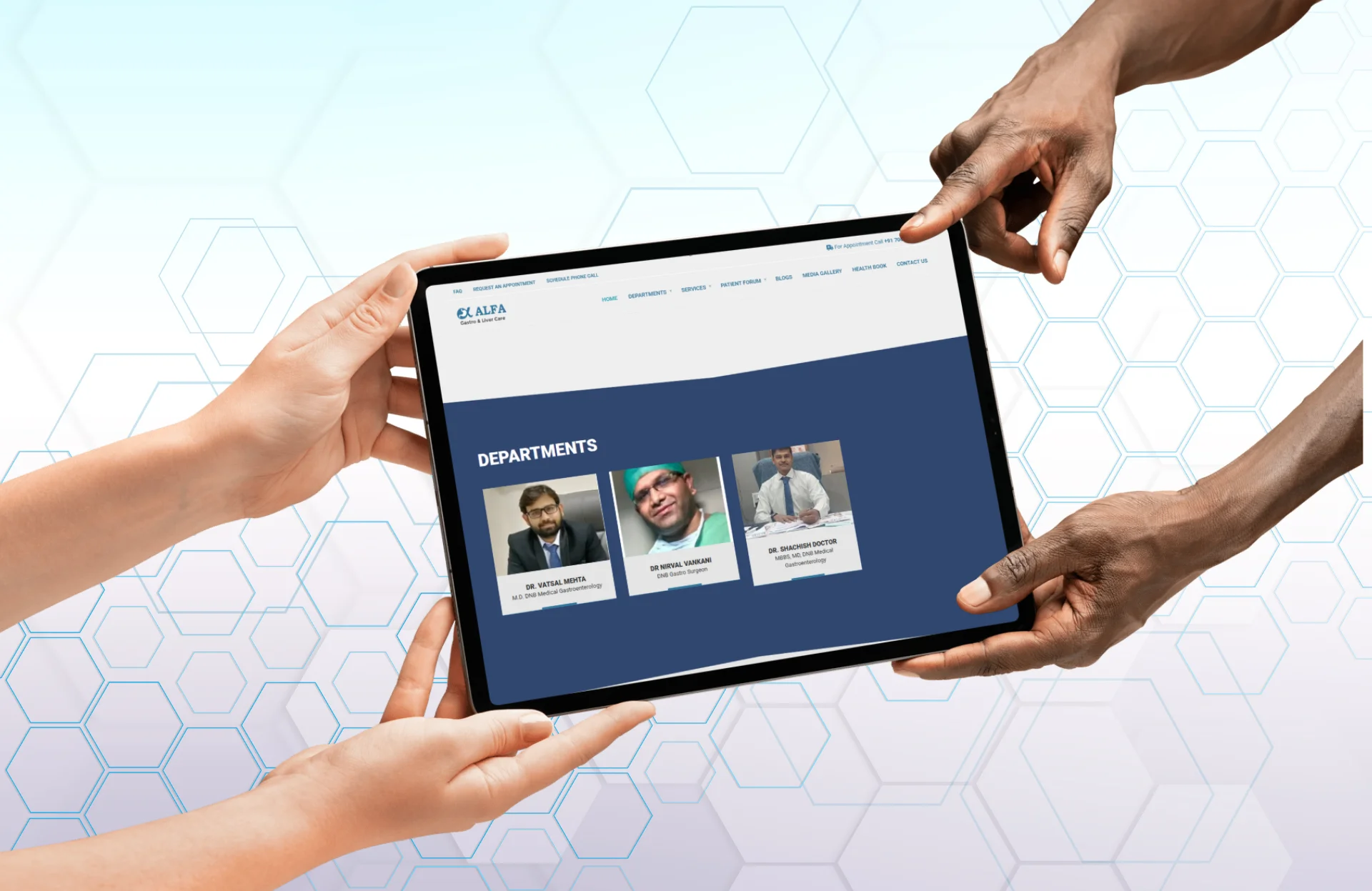
A partner who's already spent time on the clinical floor.
Our healthcare work spans large hospital networks, diagnostics groups, and life-sciences programs. Compliance, clinical workflow, and validated delivery aren't new territory for us — they're the default.
Real enterprise healthcare mileage
We've delivered inside hospital networks, diagnostics groups, and adjacent enterprise health programs — patterns that have already cleared quality and regulatory review.
HIPAA, HITECH, and GDPR by default
PHI handling, consent, audit trails, and breach-notification posture are architectural defaults, not something retrofitted before go-live.
Fluent in FHIR and HL7
FHIR R4, CDS Hooks, SMART-on-FHIR, and a long tail of HL7 v2 — interoperability is usually where our healthcare projects start, not where they stall.
Clinical-grade UX
We design with clinicians in the room. Keystroke counts, alert fatigue, and after-hours click burden are metrics we actually track and optimize against.
AI your MRM team will actually sign off on
Every clinical AI feature ships with validation benchmarks, bias monitoring, and a human-in-the-loop review queue.
Delivery built for regulated environments
Validated SDLC, traceability matrices, signed builds, and change-management artifacts are part of the sprint cadence, not bolted on at the end.
Answers for CMIOs, CIOs, and health tech founders.
Idea to Market–Ready Product
We turn your idea into a secure, compliant, and test-ready product in weeks, not months.
Inquiry & Scoping
We rapidly decompose requirements, pressure-test commercial viability, and align technical scope before capital is committed.
01 / 06